


Shri Narendra Modi
Hon'ble Prime Minister
“Skill development of the new generation is a national need and is the foundation of a self-reliant nation.”
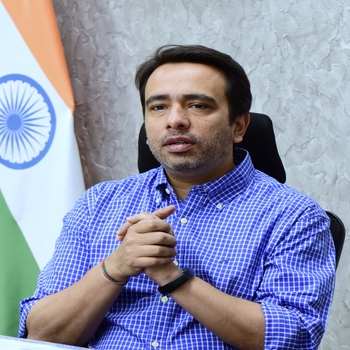
Shri Jayant Chaudhary
Hon'ble Minister of State (I/C)
“New-age competencies like AI and automation highlight the critical need for continuous learning. Our objective is to ensure that our workforce remains industry-aligned.”
Numbers That Tell The Story
Engine Behind Standardized Skill Certification
NSQF Council serves as an autonomous skill evaluation authority dedicated to mapping vocational competency standards. Our certifications are strategically designed around learning outcomes—specifying exactly what a candidate must understand, demonstrate, and execute on-site.

The 5 Core Descriptors
Every qualification level is scientifically defined across these 5 domains, organizing practical talent into structured bands.
Process (Work Context)
Evaluates the routine or unpredictable nature of the work environment. Higher levels demand strategic foresight, complex project execution, and the ability to formulate rapid systemic adaptations within changing socio-economic landscapes.
Professional Knowledge
Measures the depth, range, and focus of cognitive, factual, and theoretical information required of a candidate to comprehend, diagnose, and execute domain tasks with complete precision.
Professional Skill
Assesses practical hands-on capability, tool familiarity, physical precision, and procedural troubleshooting expertise demonstrated by the candidate during evaluation.
Core Skill
Includes fundamental structural skill sets such as mathematical or financial estimation, precise professional communication, structured IT/digital competency, and logical data analysis.
Responsibility
Evaluates organizational autonomy and project accountability, ranging from performing under strict direct monitoring (L1) to overseeing macro-budgets and strategic outcomes (L8).
13-Level Competency Mapping Matrix
Standardized Competency Tiers
| Competency Tier | Academic Level | Functional Descriptor Summary |
|---|---|---|
| Level 1 | Class 9th Eqv. | Prepares candidates for familiar, predictable, routine tasks of clear choice. Focuses on foundational technical awareness. |
| Level 2 | Class 10th Eqv. | Prepares candidates for routine execution with limited supervision. Introduces specialized procedural knowledge. |
| Level 2.5 | Class 10th + Vocational Cert. | Enables execution of basic multi-tasking activities within routine environments under close monitoring. |
| Level 3 | Class 11th Eqv. | Focuses on limited range of activities within a predictable context. Requires close guidance and core diagnostic skills. |
| Level 3.5 | Class 11th + Vocational Cert. | Equips learners to operate in familiar but occasionally unpredictable vocational contexts. |
| Level 4 | Class 12th Eqv. | Prepares learners for familiar but unpredictable contexts. Focuses on problem-solving, full responsibility of own work. |
| Level 4.5 | Class 12th + Multi-Skilling Cert. | Enhances cognitive capabilities and practical understanding of specialized domain frameworks. |
| Level 5 | Undergrad Yr 1 (Diploma) | Enables comprehensive cognitive and practical execution. Develops creative solutions to abstract issues. |
| Level 5.5 | Undergrad Yr 2 (Adv Diploma) | Prepares candidates to manage technical tasks and evaluate workflows within industrial clusters. |
| Level 6 | Bachelor's Degree | Prepares candidates to manage complex technical/professional projects. Full team accountability. |
| Level 6.5 | Bachelor's Hons Degree | Enables commanding execution of wide-ranging theoretical concepts and core practical applications. |
| Level 7 | PG Diploma Eqv. | Requires mastery of specialized theoretical principles. Formulates innovative, strategic responses. |
| Level 8 | Master's Degree | Integrates advanced theoretical knowledge with macro-management capabilities. Designs systemic solutions. |
Targeted Skilling Ecosystem
Self-Financed Courses
Market-driven, self-financed training programs operated directly by affiliated institutes and computer academies.
Learn MoreRPL Certification
Evaluating and formally certifying the uncertified workforce based on existing practical domain experience.
Learn MoreE-Learning Model
Remote digital instruction leveraging LMS video modules, interactive assessments, and online evaluation logs.
Learn MoreNCrF Credit Mapping
Translating 30 learning hours into 1 standard credit point for higher education and professional mobility.
Learn MoreResources & Services
Institutional Status & Autonomous Quality Charter
NSQF Council operates as an independent, self-governing evaluation authority and skill assessment registry. Our institutional certifications, curricula, and evaluation matrices are developed autonomously to align with core performance outcomes and occupational parameters defined within National Occupational Standards (NOS). As a private, self-regulated skill council, we provide independent certifications to training institutions, assisting them in modernizing vocational standards. We do not represent any direct governmental department, ministry, or regulatory committee, and our framework serves as an autonomous benchmark of technical excellence to boost candidate employable mobility.
Standard Ecosystem References